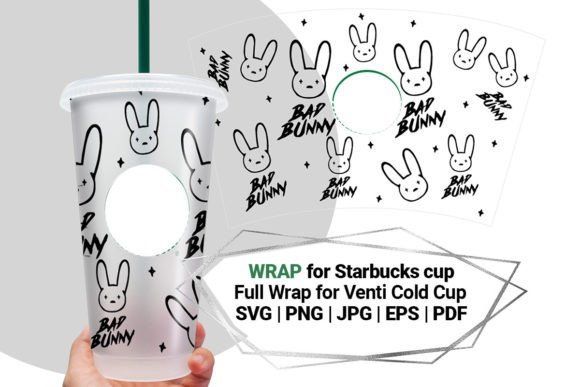
B Bunny Wrap for Starbucks Cold Cup 24
First Impressions: Playful, Bold, and Instantly Recognizable
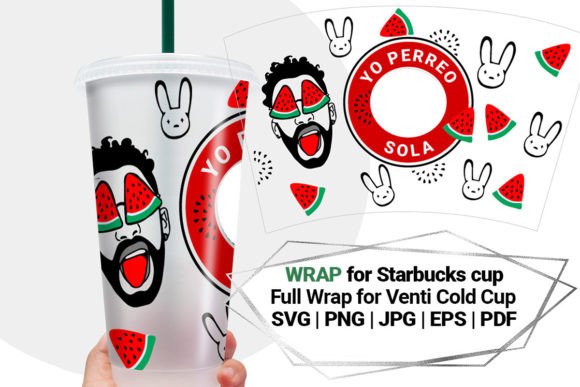
Opening the B Bunny Wrap for Starbucks Cold Cup 24 zip file, I immediately felt the energy — it’s not just a graphic; it’s a vibe. The design leans into Bad Bunny’s signature irreverent cool, but with clean lines and intentional spacing that reads well at a glance. It’s got rhythm: balanced negative space, confident curves, and a wrap-around layout built for cylindrical surfaces — though its real strength shines when translated to flat embroidery projects. As a designer who’s stitched hundreds of licensed-inspired motifs, I appreciate how this avoids overcomplication. No tiny gradients or micro-details that’ll vanish under thread. Instead, it’s got punchy silhouettes, clear letterforms, and a cohesive visual weight that holds up whether you’re stitching on a toddler’s onesie or a boutique apron.
Where This Design Truly Comes Alive
I recently tested B Bunny Wrap for Starbucks Cold Cup 24 on a custom embroidered tote bag for a local coffee shop pop-up — cotton canvas, medium-weight stabilizer, standard 4-thread satin stitch for outlines and dense fill for solid areas. The result? Sharp, confident, and unmistakably *designed*. It worked beautifully on sweatshirts (especially charcoal heather), tea towels (where the contrast popped against natural linen), and even as an embroidered patch sewn onto denim jackets. For Etsy sellers and small shop owners, this is a strong candidate for limited-run holiday gifts — think baby onesies with subtle corner placement, or personalized pillow covers for fans who love both caffeine and culture. Its playful-but-polished tone bridges streetwear and handmade charm without tipping into gimmick territory.
Real-World Embroidery Considerations
That said, B Bunny Wrap for Starbucks Cold Cup 24 isn’t universally forgiving — and that’s okay. On stretchy fabrics like jersey or thin knits, the outer curves can distort if stabilizer choice isn’t dialed in. I recommend cutaway + tear-away combo for anything with movement. On dark fabric, test your thread colors first: light gray or white satin stitch outlines need enough contrast to stay legible after washing. And while the design scales well down to ~3.5”, avoid shrinking it below 2.75” — some interior details (like the stylized “B” curve) start to blur in fill stitch density. For caps or curved surfaces, use a low-profile hoop and consider simplifying one or two inner accents manually — the file includes SVG and EPS, so vector editing is straightforward for designers comfortable with Illustrator or Inkscape.
What Works — and What Needs Thought
- Works great for: Tote bags, unisex sweatshirts, kitchen towels, embroidered patches, baby blankets (centered, not near seams), holiday mugs wraps (as a stitched-on fabric sleeve), and boutique aprons.
- Use carefully on: Lightweight rayon or silk (stabilizer must be ultra-precise), layered garments (like reversible jackets where backside stitching shows), and products requiring frequent machine washing — reinforce satin stitch edges with a second run if durability is critical.
- Avoid for: Tiny hoop projects under 3”, highly textured fabrics like bouclé or heavy corduroy (detail gets lost), and infant hats where safety standards require zero loose threads or stiff backing.
Design Integrity Meets Commercial Practicality
As a craft business owner myself, I judge embroidery files not just by aesthetics, but by how they impact customer trust and perceived value. B Bunny Wrap for Starbucks Cold Cup 24 delivers professionalism — its clean vector foundation means crisp edges in every format (SVG, EPS, PDF), and the PNG/JPEG previews are accurate enough for printable mockups. When customers see this stitched on a handmade product, they read *intention*, not clip art. That matters. For Etsy sellers listing digital embroidery files, this asset strengthens credibility — especially since it’s clearly categorized under Graphics and Crafts, fitting naturally alongside other curated design assets. Just remember: licensing is your responsibility. Confirm commercial use rights before selling finished embroidered items or reselling the digital embroidery file itself.
Pro Tips Before You Stitch
- Always run a test stitch on scrap fabric matching your final project’s weight and weave.
- Check thread color contrast on both light and dark backgrounds — don’t assume black-on-white translates cleanly to navy-on-cream.
- Review stitch density in your embroidery software — high-density fills may require slower speed or additional stabilizer on delicate fabrics.
- Verify hoop size compatibility; most versions will fit comfortably in a 4×4 or larger hoop, but confirm before hooping.
- Inspect small corners and letter junctions — some satin stitch transitions benefit from manual tie-off tweaks.
- Try a black-and-white mockup first — it reveals balance and clarity faster than color.
- Use appropriate stabilizer: cutaway for knits, tear-away for stable wovens, and fusible for lightweight linens.
- Ask yourself: does this support my brand voice? If your shop leans minimalist or vintage, this bold, contemporary motif may need thoughtful pairing — not forced inclusion.
Final Thought: A Confident Choice for the Right Project
B Bunny Wrap for Starbucks Cold Cup 24 isn’t background noise — it’s a statement piece. It performs best when treated like one: placed intentionally, stitched thoughtfully, and matched to products where personality matters. Whether you’re building a craft business, prepping for a holiday market, or designing a personalized gift that feels both current and handmade, this embroidery file earns its place in your design assets — as long as you respect its character and constraints. It won’t fix weak execution, but in skilled hands? It elevates everything it touches.