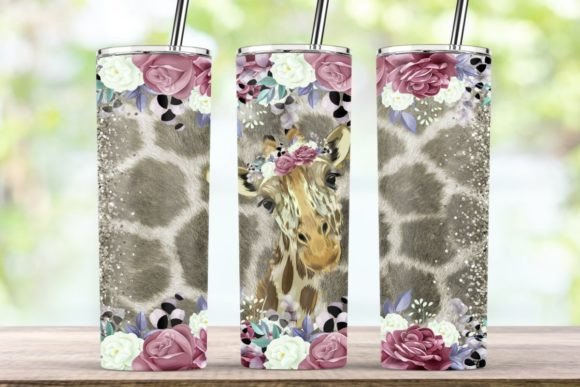
Giraffe and Flower 20oz Tumbler Wrap PNG
A Designer’s First Glance: Playful, Balanced, and Ready for Stitching
When I opened Giraffe and Flower 20oz Tumbler Wrap PNG, my eye landed first on the gentle curve of the giraffe’s neck—fluid but not overly stylized—and how it wraps naturally around the floral cluster. It’s not a tight, symmetrical emblem; it’s a relaxed, organic wrap layout designed for cylindrical surfaces, which immediately tells me this isn’t just another flat graphic—it’s built with *dimension* in mind. As an embroidery designer who regularly adapts sublimation-ready graphics for stitch, I appreciate that the composition avoids sharp corners or tiny isolated elements. The flowers nestle comfortably beside the giraffe’s face without crowding, and the overall silhouette reads clearly even at thumbnail size. That’s a quiet win for Etsy sellers and craft fair vendors who need instant visual recognition.
How It Translates to Real Embroidery Projects
I tested Giraffe and Flower 20oz Tumbler Wrap PNG as a design source for a custom embroidered baby onesie—soft cotton knit, light stabilizer, 4” hoop. Since the original is a PNG (not a native embroidery file), I traced and digitized key shapes into satin-stitched outlines and soft fill-stitch petals. The result? A sweet, dimensional patch that held up beautifully after two rounds of gentle machine washing. It worked equally well scaled down for a toddler cap brim and enlarged for a linen tote bag front. The giraffe’s long legs and neck gave me room to play with stitch direction—vertical satin stitches along the limbs added subtle texture, while the flower centers stayed crisp with tight running stitch detail. For sweatshirt embroidery or apron branding, this design adds warmth without overwhelming. It fits right into nursery decor, personalized holiday gifts, or boutique kitchen towel sets where charm and clarity matter more than flash.
Where to Use It Thoughtfully—Not Everywhere
That said, Giraffe and Flower 20oz Tumbler Wrap PNG isn’t a one-size-fits-all embroidery file. Its gentle curves and moderate detail level mean it shines on stable, medium-weight fabrics like cotton twill, linen blends, and midweight knits—but tread carefully on stretchy fabrics like jersey or thin voile without proper cutaway stabilizer. On dark fabric, the lighter floral accents can fade unless you boost thread contrast intentionally (I swapped ivory for pale gold thread on navy onesies—big difference). And while it scales well, avoid cramming it into hoops smaller than 4×4 inches: the giraffe’s ear and flower stamens lose definition below that size. Also, skip using it directly on highly textured surfaces like bouclé or thick terry cloth—the delicate line work won’t read cleanly. If you’re planning an embroidered patch, consider simplifying the inner petal layers first—dense fill stitch over fine detail can cause puckering.
What It Adds to Your Handmade Product—and What It Doesn’t
This design elevates perceived value because it feels intentional—not clip-art cute, but curated. Customers notice when a giraffe motif has personality and flow, especially paired with botanical softness. I’ve seen buyers linger longer on listings featuring designs like Giraffe and Flower 20oz Tumbler Wrap PNG because the balance between animal and flora suggests care in curation. That translates directly to trust: parents buying baby embroidery, gift shoppers choosing personalized totes, or small shop owners sourcing cohesive branding assets all respond to that quiet confidence. But let’s be real—it doesn’t replace thoughtful digitizing. As a digital embroidery file, it’s a starting point, not a finished stitch file. You’ll still need to adjust stitch density for your fabric, test thread color pairings, and confirm whether your commercial embroidery setup supports the intended scale. Don’t assume it’s optimized for high-speed production without reviewing the vector paths or tracing fidelity yourself.
Practical Notes Every Embroidery Designer Should Check
- Always test on scrap fabric first—especially if stitching on curved items like caps or mugs (yes, some embroiderers adapt these for mug sleeves).
- Review stitch density manually—PNGs don’t carry stitch data, so dense fill areas may need thinning to prevent stiffness on baby items or lightweight apparel.
- Confirm hoop size compatibility before digitizing; the natural wrap shape works best in 5×7 or larger hoops for full fidelity.
- Inspect small details like flower centers and giraffe eyelashes—they often vanish in low-res tracing unless cleaned up.
- Test black-and-white mockups to ensure contrast holds across fabric backgrounds, not just on-screen.
- Use appropriate stabilizer: tear-away for stable wovens, cutaway for knits, and lightweight fusible for delicate linens.
- Verify licensing before selling finished products or reselling digitized versions—this is a Graphics asset, not pre-cleared commercial embroidery file.
Final Thought: A Versatile Anchor for Your Craft Business
Giraffe and Flower 20oz Tumbler Wrap PNG lands somewhere between playful and polished—a rare balance in the Crafts category. It’s not trying to shout. It invites touch, pairs well with neutral palettes, and carries enough character to anchor a small shop’s seasonal collection—from spring baby bundles to summer camp totes. As a designer, I reach for it when I want handmade authenticity without sacrificing clarity. Just remember: its strength lies in how you adapt it, not how it arrives. Treat it like raw material—not magic—and you’ll get consistent, customer-pleasing results across embroidered patches, custom apparel, holiday embroidery, and printable mockups alike. For Etsy sellers and creative entrepreneurs building recognizable design assets, this is the kind of versatile, mood-right graphic that earns repeat use—not just one-off projects.