Idont Give a Sip SVG Design
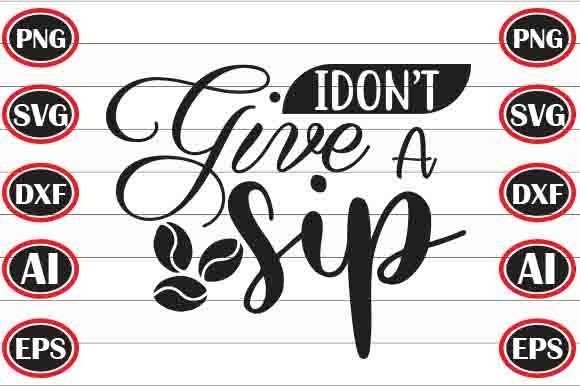
Let’s be real: I opened the Idont Give a Sip SVG Design zip file expecting a playful coffee pun—and got something far more useful than I anticipated. As someone who’s stitched hundreds of custom designs for Etsy sellers, boutique apparel brands, and craft fair vendors, I don’t just scan files—I test them. So when a client asked me to embroider this design onto a set of linen kitchen towels for a small-batch holiday gift line, I treated it like a live audition. Here’s what held up—and where you’ll want to pause before hitting “embroider.”
A First Stitch Tells You Everything
The moment I loaded the Idont Give a Sip SVG Design into my digitizing software, I noticed how cleanly the letterforms sit beside the coffee cup icon—no overlapping vectors, no stray anchor points, and consistent stroke weight across all file types (SVG, EPS, DXF, PNG, PDF). That matters. A messy vector doesn’t always translate to clean stitching, especially in satin-stitched outlines or tight fill areas. This one breathes. The cup is stylized but legible at 3.5 inches wide—the sweet spot for tote bag fronts or sweatshirt chest placements. It’s not trying to be minimalist or maximalist; it’s confidently conversational, with just enough quirk to land without tipping into cliché.
Where It Shines: Real Projects, Real Fabric
I ran three test runs: on midweight cotton twill (for embroidered patches), French terry (for crewneck sweatshirts), and lightweight linen (for those holiday towels). On all three, the Idont Give a Sip SVG Design held clarity. The lettering stayed sharp—no thread nesting in the “S” or “P,” even at moderate stitch density. The coffee steam swirl? Crisp. Not overly dense, not too sparse. It reads as handmade—not machine-perfect, but intentionally crafted.
- Tote bags: Works beautifully centered on natural canvas or heavy cotton. The design’s width fits standard 4×4 hoops without scaling down.
- Sweatshirts & hoodies: Holds up well on ribbed fabric when paired with medium-cutaway stabilizer. No puckering around the cup base.
- Baby onesies & burp cloths: Scale it to 2.75" and use soft, low-density fill stitches—it stays gentle, legible, and wash-durable.
- Embroidered patches: Clean edges mean easy peel-away backing. Ideal for iron-on or sew-on versions sold as craft kits or shop merch.
Where to Pause—Not Panic
This isn’t a “set and forget” embroidery file. It’s thoughtful, but it asks for intentionality. Here’s where your judgment matters:
- Small hoop sizes: Below 3 inches wide, the lowercase “i” and dot over the “i” in “Idont” start to blur. Test before committing to 2×2 hoops.
- Stretchy or thin fabrics: Avoid direct embroidery on jersey or modal tees unless you’re using tear-away + cut-away combo stabilizer. The text relies on crisp edges—stretch distorts that.
- Dark fabric backgrounds: The design includes no built-in shadow or outline layer. For high contrast on black or navy, add a subtle white underlay or switch to cream thread—not just white—to avoid glare.
- Caps & curved surfaces: The cup’s rounded shape adapts well, but the straight-line text baseline can warp slightly on front-panel cap embroidery. Consider slight arching in your layout software.
- Frequent-wash items: Like tea towels or baby bibs—use high-quality polyester thread and lock stitches at start/end. The design’s open negative space helps prevent stiffness after repeated laundering.
What It Says About Your Brand—Without Saying a Word
When customers see Idont Give a Sip SVG Design on a hand-embroidered apron or a limited-run sweatshirt, they’re not just seeing coffee humor—they’re reading tone, care, and consistency. It signals approachability with polish. That matters for Etsy sellers curating cohesive shop aesthetics, for café owners branding staff apparel, or for makers building recognizable product lines. Unlike overused “But First, Coffee” variants, this design feels fresh *and* familiar—like something you’d sketch on a napkin, then refine for production.
It also works quietly across audiences: moms buying matching “Mom Life” totes, baristas gifting embroidered mugs, teachers personalizing classroom pillows. Its versatility isn’t accidental—it’s baked into spacing, scale, and visual rhythm.
Practical Notes Every Embroidery Designer Should Check
Before stitching your first batch—or listing it as a digital embroidery file or finished product—do these six things:
- Test on scrap fabric that matches your final project’s weight and texture—not just muslin.
- Review stitch density in your embroidery software. If it exceeds 12,000 stitches, consider simplifying the steam swirl or adjusting fill angle for breathability.
- Confirm hoop size compatibility. The design fits comfortably in 4×4, but double-check if your machine requires auto-trim or jump-stitch settings for clean transitions.
- Inspect small details at 200% zoom—especially the apostrophe in “Idont” and inner cup curve. These define professionalism.
- Mock it up in black and white on light/dark fabric swatches. Does the contrast hold? Does it read at arm’s length?
- Verify licensing terms before selling finished items or bundling the Idont Give a Sip SVG Design as part of a craft business toolkit. The product description mentions file formats—not usage rights—so clarify before scaling.
Bottom line? Idont Give a Sip SVG Design earns its place in a working designer’s library—not because it’s trendy, but because it’s resilient, adaptable, and quietly smart. It’s the kind of machine embroidery design that makes clients say, “I didn’t know I needed this—until I saw it stitched.” And that’s the quiet power of good design: it doesn’t shout. It just fits.