Vintage Car Tumbler Wrap 20oz Skinny
As a designer who’s stitched everything from baby onesies to boutique aprons over the past 14 years—and reviewed hundreds of digital embroidery files—I opened Vintage Car Tumbler Wrap 20oz Skinny expecting nostalgic charm, but what stood out immediately was its quiet confidence: clean lines, balanced negative space, and a shape that feels purpose-built—not just for sublimation tumblers, but for thoughtful embroidery adaptation.
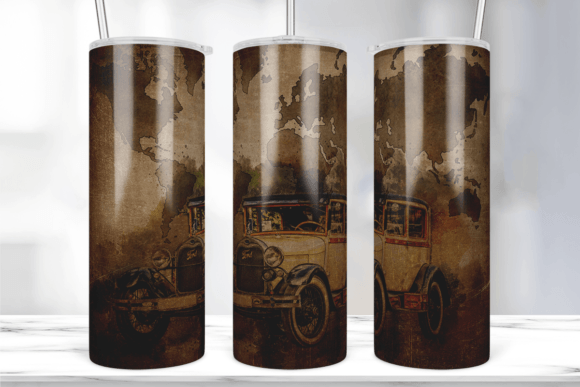
I tested it on a custom embroidered tote bag for a local coffee roaster’s holiday pop-up. The design sat perfectly along the bottom third of the canvas—neither shouting nor shrinking. That’s rare. Many “vintage car” motifs lean too busy or too cartoonish, but this one lands with warmth and restraint: a streamlined silhouette, subtle tire treads, soft curve accents, and just enough detail in the grille and headlights to read clearly at 3.5 inches wide. It doesn’t try to be a full scene—it’s a *wrap*, and it wraps well.
This isn’t a machine embroidery design out of the box—but as a Graphics file (PNG), it’s an excellent starting point for digitizing. Its vector-ready edges and consistent 300 DPI resolution mean crisp scaling without pixelation, whether you’re prepping it for a 4-inch hoop on a sweatshirt or shrinking it down for a delicate baby embroidery on a cotton bib. As a Print Templates asset, it’s flexible—but remember: PNGs need digitizing before stitching. Don’t assume it’s stitch-ready.
In real-world use, Vintage Car Tumbler Wrap 20oz Skinny shines brightest on medium-weight fabrics where structure supports clarity: twill tote bags, brushed cotton sweatshirts, linen tea towels, and structured cap fronts. On a lightweight jersey tee? I’d simplify the grille detail or reduce stitch density—those fine horizontal lines can blur if the fabric shifts under the needle. On dark fabric, it reads beautifully with high-contrast thread (navy + cream or charcoal + antique gold), but avoid pairing it with overly shiny or metallic threads—the vintage mood leans matte and tactile, not flashy.
Where it demands care: curved surfaces like baseball caps or tapered pillow covers. The wrap’s natural arc helps, but the front bumper area compresses slightly when hooped tightly on a rounded surface—so test stitch on scrap first, and consider slight manual adjustment to preserve symmetry. Also, skip it on ultra-thin baby knits unless you’re using lightweight stabilizer and reducing fill stitch density. Those tight satin-stitch curves around the wheel wells can pucker delicate weaves.
For Etsy sellers and craft business owners, this design quietly elevates perceived value. It doesn’t scream “trend”—it whispers “curated.” Customers browsing personalized gifts or small shop merchandise respond to its authenticity: no clipart stiffness, no forced whimsy. When stitched onto a denim apron for a mechanic’s birthday or a wool-blend blanket for a car collector’s nursery, it feels intentional—not decorative filler. That builds trust. That encourages repeat buyers.
It also works hard behind the scenes. As a digital embroidery file foundation, it translates cleanly into printable mockups—ideal for listing previews on Etsy or Instagram. I dropped it into a neutral kitchen towel mockup (light and dark versions), and the contrast held up without color correction. For commercial embroidery projects, its balanced proportions mean fewer client revisions: it fits standard hoop sizes without awkward cropping, and its centered composition avoids awkward placement decisions.
Here’s what I always do before committing Vintage Car Tumbler Wrap 20oz Skinny to a finished product:
- Test stitch on scrap fabric matching my project’s weight and stretch—especially if using textured weaves like waffle cloth or looped terry.
- Check thread color contrast in natural light—not just screen light. Vintage palettes (olive, rust, cream) can mute on beige fabric.
- Review stitch density in the headlight and grille areas. Too dense = stiff embroidery; too sparse = lost detail.
- Confirm hoop size compatibility. At full scale, it fits comfortably in a 5x7 hoop—but if resizing for a child’s cap, verify it clears the 4x4 boundary.
- Inspect tiny details in black-and-white mockups. If the bumper line disappears in grayscale, it’ll vanish on dark fabric.
- Use tear-away + cut-away hybrid stabilizer for structured items (totes, aprons); switch to lightweight fusible for baby items.
- Verify licensing terms before selling finished embroidered goods—or reselling digitized versions. This is a Graphics file for instant download, not an all-rights bundle.
It’s not the flashiest design in your library—but it’s one of the most reliable. I’ve used variations of it for embroidered patches on vintage-style workshop jackets, as a subtle accent on linen napkin sets for auto-themed weddings, and even resized for a minimalist holiday ornament (stitched on wool felt, backed with flannel). Each time, it landed with sincerity—not gimmickry.
If you’re curating design assets for a craft business or building a cohesive collection of handmade products, Vintage Car Tumbler Wrap 20oz Skinny earns its place not because it’s trendy, but because it’s *adaptable*, *thoughtful*, and *visually honest*. It respects the material it’s stitched on—and the person wearing or gifting the finished product. That’s the kind of detail that turns a quick Etsy order into a five-star review and a returning customer.
Bottom line: this isn’t just another tumbler wrap. It’s a quiet, confident design asset—one that works as hard for your small shop as it does for your next personalized gift, holiday embroidery, or boutique branding project.