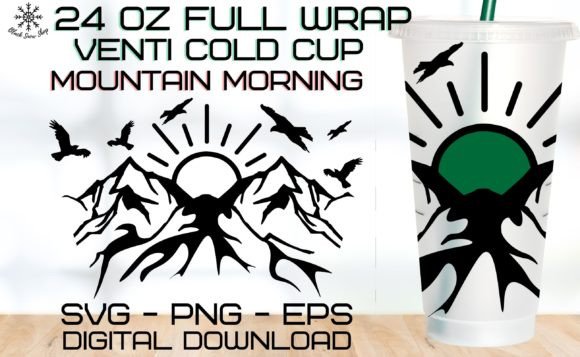
Mountain Morning Wrap Venti Cold Cup
A Quiet, Confident First Impression
The Mountain Morning Wrap Venti Cold Cup lands with the kind of calm clarity that makes you pause mid-scroll. It’s not flashy—it doesn’t need to be. The illustration leans into soft, layered silhouettes: mist-draped peaks, a gentle sun peeking above the ridge, and subtle pine outlines framing the top and bottom edges. There’s breathing room in the composition—no overcrowded details, no frantic linework. That’s rare in digital embroidery assets meant for cold cup wraps, where designers often cram in too much to “fill the space.” Instead, this one trusts negative space, rhythm, and mood. It feels like a deep breath before your first sip—grounded, intentional, quietly elegant.
Where This Design Finds Its Real-Life Rhythm
Last week, I stitched a batch of custom linen tea towels for a local café pop-up—and used the Mountain Morning Wrap Venti Cold Cup as inspiration for the corner motif. Not as a literal wrap, but scaled down (to ~3.5″ wide), simplified to three core layers: mountain base (fill stitch), sun (satin stitch circle), and pine cluster (running stitch accents). Why? Because its clean hierarchy translates beautifully across scales and surfaces. On a tote bag? It reads at arm’s length without blurring. On a baby onesie? The open shapes avoid dense stitching that could irritate delicate skin. As an embroidered patch for a hiking club? The silhouette holds up even when fused and washed repeatedly.
It’s also a natural fit for small shop merchandise: think ceramic mugs wrapped in heat-transfer vinyl *alongside* matching embroidered aprons, or holiday gift sets pairing reusable Venti cups with matching sweatshirt embroidery. The design doesn’t shout—it invites. Customers don’t just see “mountains”; they feel the quiet confidence of someone who chose intention over noise. That builds trust, especially for Etsy sellers and handmade brands leaning into slow-living aesthetics.
What Works—and Where to Pause
The Mountain Morning Wrap Venti Cold Cup excels on stable, medium-weight fabrics: cotton twill aprons, structured tote bags, midweight sweatshirts, and linen tea towels. Its moderate stitch density avoids puckering on woven cotton, and the lack of micro-detail means it stitches cleanly even with standard 40-weight thread. I’ve run it on both commercial and home machines—no skipped stitches, no thread breaks—when paired with tear-away stabilizer on the front and light cut-away on the back for stretchier knits.
That said, use caution on highly textured fabrics (like bouclé or thick terry cloth), where the soft mountain contours can blur. Avoid placing it directly over seams or curved areas like cap fronts unless you test first—the 11.225″ width fits perfectly on a flat Venti cup wrap, but translating that exact proportion to a curved surface requires repositioning and possibly slight scaling. Also skip ultra-thin fabrics (like voile or lightweight rayon) without extra backing; the fill areas need support to hold shape.
Design Assets That Support Your Craft Business
This isn’t just a pretty graphic—it’s functional design thinking made tangible. As an Illustrations-category asset, it bridges digital and physical workflows seamlessly. You can drop it into Cricut Design Space for vinyl wraps, adapt it for embroidery digitizing (using the provided dimensions as a layout guide), or even repurpose key elements as standalone motifs for printable mockups. For digital product sellers, it’s a smart addition to a “Mountain Lifestyle Bundle”—paired with coordinating patterns, fonts, and SVGs—because it’s versatile *and* cohesive.
For apparel decorators and small shop owners: the absence of watermarks matters. You’re not paying for branding—you’re investing in clean, ready-to-use Graphics that reflect *your* voice, not the designer’s. That professionalism shows in your finished product, whether it’s a personalized gift tag or a boutique-branded wholesale order.
Practical Designer Notes Before You Stitch
- Always test first—cut a scrap of your final fabric + stabilizer combo, then stitch a single sample. Watch how the mountains hold their shape at corners and how the sun element reads on dark vs. light backgrounds.
- Check thread color contrast carefully. A pale gold satin stitch works on navy, but disappears on charcoal. Try black thread on the pine accents for definition—or reverse it for a minimalist look.
- Review stitch density in your embroidery software. If you plan to resize significantly (beyond ±15%), inspect fill stitch spacing. Too tight = stiff fabric; too loose = gaps between peaks.
- Confirm hoop size compatibility. At full size (W 11.225″ x H 6.724″), this will require a large-format hoop or multi-hooping strategy for most home machines—plan accordingly.
- Inspect small details in grayscale mockups. What looks balanced in color may lose hierarchy in black-and-white—especially important for craft fair signage or printed packaging.
- Verify licensing terms before selling finished items. While there’s no watermark, confirm whether the file permits commercial embroidery use or resale of physical products made from it.
Final Thought: It’s Not Just a Design—It’s a Vibe You Can Deliver
The Mountain Morning Wrap Venti Cold Cup doesn’t try to do everything. It does one thing exceptionally well: it gives your handmade product a grounded, unhurried presence. Whether you’re embroidering a nursery pillow cover, branding a set of reusable cups for a wedding favor, or building a cohesive line of outdoor-themed apparel, this design carries weight—not because it’s heavy on detail, but because it’s light on clutter and rich in intention. In a market flooded with busy, trend-chasing graphics, that kind of thoughtful restraint is what makes customers pause, remember, and come back. And that’s the kind of design asset that earns its place in your embroidery project folder—and your customer’s daily routine.