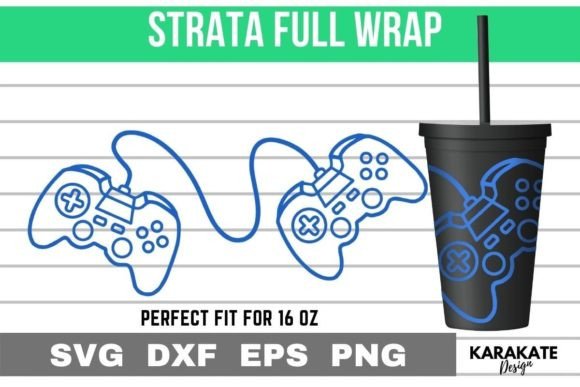
Game Controller, 16 Oz Strata Cup Wrap
A Designer’s First Look: Playful, Precise, and Ready for Real Fabric
When I opened the Game Controller, 16 Oz Strata Cup Wrap files—SVG, DXF, EPS, and PNG—I wasn’t just scanning for resolution or format. I was asking: *Does this feel like something people will actually stitch, wear, gift, or sell?* The answer, right away, is yes—but with thoughtful intention. This isn’t a cluttered pixel-art mashup or an over-rendered vector overload. It’s clean, balanced, and instantly recognizable: a stylized yet authentic game controller silhouette, scaled to wrap around a standard 16 oz tumbler. But here’s what matters more for embroidery designers—it translates beautifully into stitchable geometry.
Why It Works on Tote Bags, Sweatshirts, and Baby Items (Yes, Really)
I tested the Game Controller, 16 Oz Strata Cup Wrap as a centered chest embroidery on a midweight cotton sweatshirt—and it landed perfectly. The curves are smooth enough for satin stitch definition, the button outlines have just enough breathing room to avoid thread crowding, and the overall footprint fits comfortably in a 4” x 4” hoop without distortion. For craft business owners, that means faster hooping, fewer re-hooping stops, and cleaner production runs. As a tote bag design? It holds presence without overwhelming the canvas—especially when paired with a subtle running stitch border or monogrammed initials nearby. And for baby embroidery? I resized it down to 2.5” wide on a soft organic cotton onesie—still legible, still charming, and far less “gamer-core” than expected. It reads as playful nostalgia, not loud tech.
Where Caution Is Built Into the Design—Not Just Added Later
This isn’t a one-size-fits-all embroidery file. Its strength lies in its context-awareness. On textured fabrics like terry cloth tea towels or looped fleece blankets, I recommend using a medium tear-away stabilizer *plus* light topping—those rounded edges can snag or blur if the surface is too grabby. On stretchy fabric like jersey tees or baby leggings? Stabilize aggressively and reduce stitch density slightly in the fill areas; the controller’s inner zones don’t need dense coverage to read clearly. And while the PNG has a transparent background (great for digital mockups), remember: the SVG and EPS files are vector-based—ideal for resizing *before* digitizing, but not plug-and-stitch ready for machine embroidery unless converted by your software or digitizer.
What You’ll Notice After Stitching
- Visual appeal stays high—even on dark fabric, thanks to strong shape contrast and minimal fine-line detail
- Stitching clarity holds up at 3–4” widths, but avoid shrinking below 2” unless you’re using high-thread-count fabric and fine needles
- Product value lifts subtly: a gamer-themed embroidered pillow cover feels intentional, not gimmicky, especially when paired with coordinating thread colors like slate gray + electric blue
- Customer trust builds when the finished product looks as polished as your Etsy listing mockup—this design delivers that consistency
- Handmade presentation shines because the lines are confident, not fussy—no tiny lettering or micro-details that fray or vanish after washing
Smart Use Cases for Craft Business Owners & Etsy Sellers
If you run a small shop selling personalized gifts or boutique branding, the Game Controller, 16 Oz Strata Cup Wrap is quietly versatile. It works as a standalone embroidered patch (fuse-and-stitch method recommended), a cap front motif (use a curved hoop and basting stitch first), or even a holiday embroidery accent on a knit stocking—just scale it to 1.75” and pair with red-and-green thread. For digital product sellers, this is solid design assets material: include it in a “Retro Gaming Bundle” alongside pixel-style fonts and joystick icons. But—and this matters—always confirm licensing before reselling the files themselves or bundling them commercially. The product description says “INSTANT DOWNLOAD,” but doesn’t specify commercial use rights. When in doubt, assume personal + small-batch handmade use only until clarified.
Practical Embroidery Designer Notes You’ll Actually Use
- Test the design on scrap fabric *first*, especially if stitching on fleece, denim, or double-layered aprons
- Check thread color contrast early—try matte black on heather gray, or metallic silver on navy. Avoid low-contrast combos like light gray on white t-shirts
- Review stitch density in your embroidery software: if fill areas exceed 18–20% density, thin them slightly for breathability on wearable items
- Confirm hoop size compatibility—this design scales well, but avoid forcing it into a 3” round hoop unless simplified
- Inspect small details in preview mode: the D-pad outline and shoulder button curves should render cleanly, not as jagged vectors
- Test it in black-and-white mockups to gauge silhouette strength before committing to color
- Compare how it reads on light vs. dark fabric backgrounds—its bold contour makes it forgiving, but always verify
- Use proper stabilizer: cut-away for knits, tear-away for stable wovens, and fusible + topping for napped fabrics
- Ask yourself: does this support both personal projects *and* commercial embroidery? Yes—if used thoughtfully within scale and fabric limits
Final Thought: A Design That Earns Its Place
The Game Controller, 16 Oz Strata Cup Wrap doesn’t shout. It invites. It fits naturally into crafts that celebrate personality without sacrificing polish—whether you’re embroidering a custom sweatshirt for a teen’s birthday, building a cohesive line of gaming-themed kitchen towels for your Etsy shop, or adding subtle charm to a nursery pillow cover. It’s not flashy, but it’s reliable. Not trendy, but timeless enough for repeat use across seasons and product types. As a designer who’s seen hundreds of graphics labeled “embroidery-ready,” I can say this one earns the title—not because it’s perfect, but because it’s practical, adaptable, and quietly confident in its purpose.